
Blog
Desert Rose in Winter: Why the Leaves Drop and How to Water a Sleeping Caudex

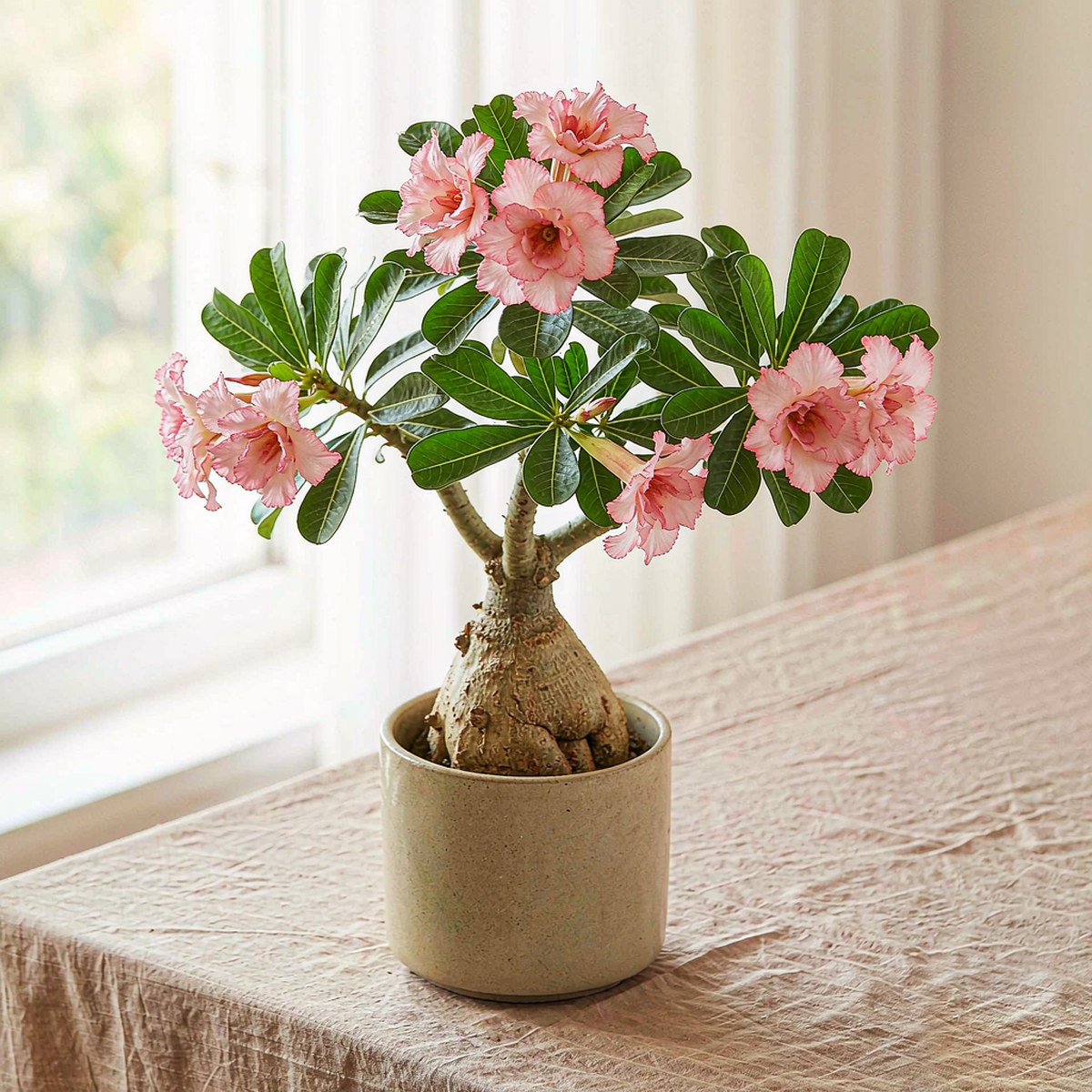
Quick answer: A desert rose that sheds every leaf in late autumn is going dormant, not dying. Move it indoors before nights fall below 50°F, give it the brightest window you have, and stop watering to a calendar — water only when the caudex gives slightly under a gentle squeeze. Cold combined with wet compost is what kills an Adenium; cold and dry almost never does.
Leaf drop is the plan, not the problem
Adenium obesum comes from the dry tropics of East Africa and the Arabian Peninsula, where the year divides into a wet growing season and a long, rainless rest. The swollen caudex is a water tank built for that rest. When days shorten and nights cool, the plant lets its oldest leaves yellow and fall, cutting the surface area that loses water. A bare stick with a fat base in December is executing an inherited instruction.
What is not normal is a caudex that softens while leaves still hang on it, or dark patches creeping up from the soil line. That is rot, and it needs action rather than patience.
Three temperature numbers that decide the winter
Desert rose is reliably hardy only in zones 10 and 11. Everywhere else it is a container plant with a narrow comfort band, and the difference between a good spring and a dead caudex is often one cold November night you were still thinking about.
| Night temperature | What the plant is doing | What you should do |
|---|---|---|
| Above 65°F | Growing and flowering normally | Normal watering and feeding |
| 60–65°F | Growth slowing, last flowers finishing | Stretch the interval; stop feeding |
| 50–60°F | Semi-dormant, lower leaves yellowing | Full sun, almost no water, no feed |
| 40–50°F | Dormant, often fully leafless | Keep dry; shield from cold glass and draughts |
| Below 40°F | Injury begins; frost turns tissue to mush | It should already be inside |
Bring it in early, not on the night of the first frost warning. A plant moved indoors in October costs nothing. One caught at 34°F on an unheated porch can lose the whole caudex in a week.
The squeeze test: watering a plant with no leaves
This is the step most people get wrong. Below 60°F the roots stop taking up water at summer speed, and a leafless plant is transpiring almost nothing. Water in the compost has nowhere to go, and in a cool room it sits there for weeks.
So water on evidence. Press the caudex between thumb and fingers: firm and plump means do nothing; slightly yielding or faintly wrinkled means a light morning watering, then stop. Never water into compost that is already damp. Some growers water twice all winter, others not at all, and both plants come back. The fortnightly soak carried over from summer by habit is the only real mistake.
Why cold-and-wet kills, and dry-and-cold does not
The classic winter death of a desert rose is not freezing. It is a caudex that sat in wet compost at 55°F for three weeks. Cold slows metabolism and water uptake; wet compost keeps the root zone anaerobic; the base of the trunk, sitting half-buried in most mixes, rots from the soil line upward. By the time the caudex looks sunken, the process has been running for a month.
Drainage is therefore the second half of winter care: a mix at least a third grit, pumice or coarse bark, drainage holes that are genuinely open, and no saucer holding runoff. Fix that before the plant comes inside rather than after the first yellow leaf — the same principle that governs planting in heavy, wet soil.
The week you bring it in
- Check leaf undersides for mites. Pale stippling or faint webbing at the leaf axils means treat now, outdoors, where you can hose the plant down.
- Clear the drainage holes. Roots and grit compact into them over a season; a blocked hole is a slow drowning.
- Let the pot dry almost completely before it crosses the threshold, so it enters the cool room already dry.
- Choose the brightest spot indoors — south or south-west, four hours of direct sun, not a shaded corner chosen because the plant is resting.
- Keep it off cold glass. A windowsill runs several degrees colder than the room after dark; bubble wrap behind the pot solves it.
- Do not repot, prune or feed. All three invite rot or stall a plant that cannot heal.
Spider mites: the pest winter guarantees
Dry indoor air suits two-spotted spider mites, and a desert rose is one of their preferred hosts. Damage is easy to miss until advanced: leaves look as though someone dusted them with flour, then bronze and drop. Check the undersides, where the colony lives, and look for fine silk where leaf meets stem.
Treat before the plant comes indoors. Rinse the foliage, undersides especially, then apply insecticidal soap or neem to every surface including stems. Repeat every seven days for three rounds, because these products kill active mites and not eggs. One application is a reset, not a cure. Turn the pot a quarter turn every two weeks as you work, or an unrotated Adenium grows sideways out of the rim by March.
Leave the shears and the repotting until spring
Repotting in autumn damages fine roots exactly when the plant cannot repair them, and fresh compost holds moisture against a dormant caudex. Wait for new growth in April, then move up one pot size at most.
Hard pruning is the same story. Adenium answers a spring cut with several flowering shoots; an autumn cut is an open wound in cool, humid air. If a damaged branch must come off, cut cleanly, dust with sulphur and keep the plant dry until it calluses. The sap is irritating, so wear gloves and eye protection. Our Stephania caudex wake-up guide covers the same stalled-caudex logic.
Telling dormancy from rot
Both look like a bare plant in a pot, so judge the base rather than the top. A dormant caudex is firm, evenly coloured and may be slightly wrinkled; the soil is dry; there is no smell. A rotting one is spongy at the soil line, often darker on one side, and the compost smells sour. In doubt, unpot it: healthy roots are pale and firm, rotting ones brown and stringy.
For rot, cut back to clean tissue with a sterile blade, dust with sulphur and let the cut callus in dry air for several days before repotting into fresh gritty mix. Do not water for a week. The plant may look severe for months and still recover. Our notes on keeping bulbs dry through winter rest on the same rule: airflow and dryness beat warmth.
March: reading the wake-up signals
Wait for the plant, not the calendar. The first sign is a swelling at the leaf scars, then small tight leaves pushing from the branch tips. Only then should watering go from a moistening to a proper soak, and only when nights are reliably above 60°F should feeding resume at half strength.
Move it back outside over a week, starting in shade, because April sun on winter-soft tissue scorches. A named flowering form with a well-formed caudex is worth starting with: our deep velvety desert rose and the crowded-cluster caudex form both show the architecture that makes the winter silhouette worth the patience, while the compact layered-petal selection is easier to rotate on a windowsill.
Get the winter right and the reward arrives in June, when a plant that looked dead for four months covers itself in bloom. Browse the full spring range for companions, or start with the pure layered-bloom caudex and the sunlit desert rose.