
Blog
When to Fertilize Flower Bulbs: A Feed Calendar That Actually Works

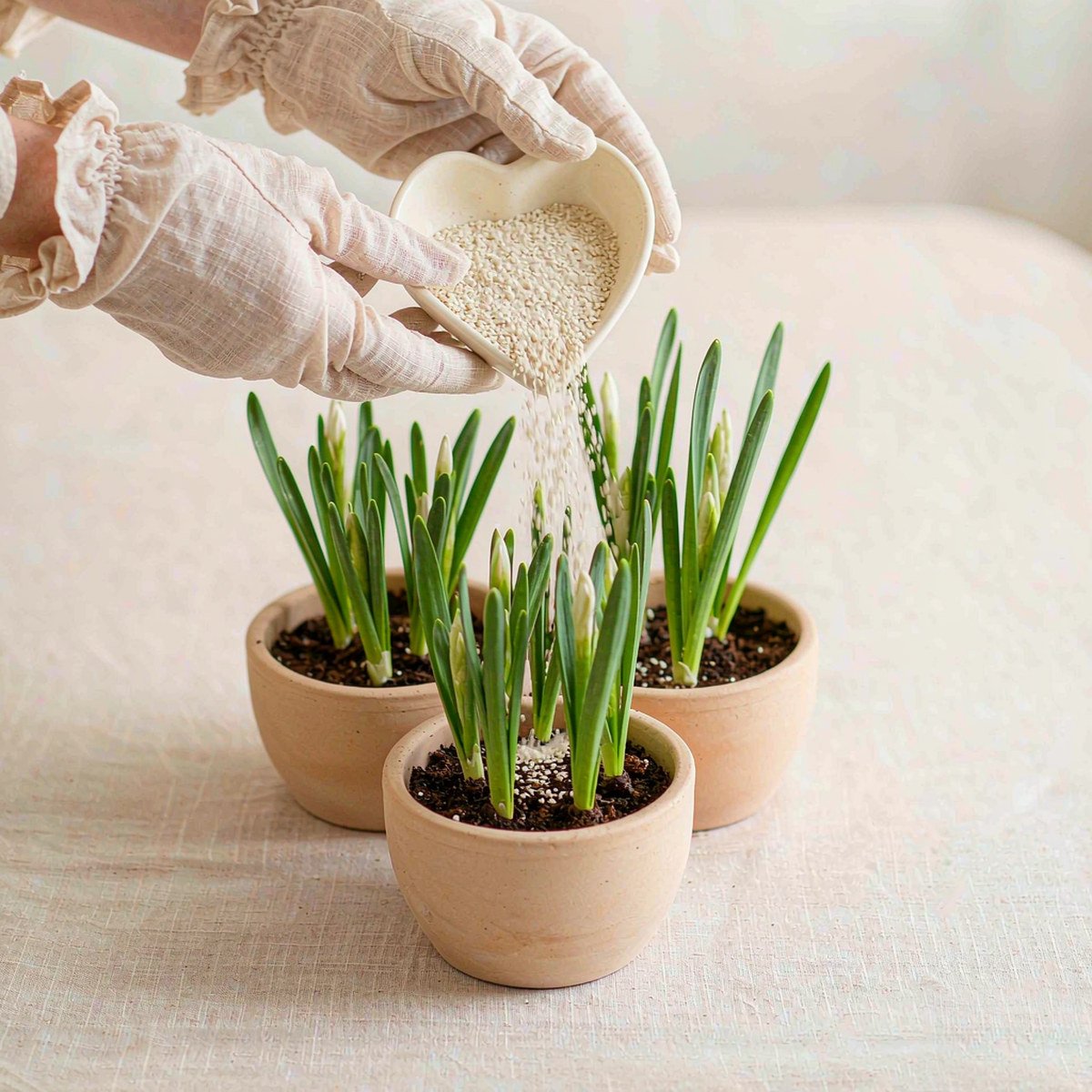
Quick answer: Feed spring bulbs twice — once when the shoots break the soil in late winter, and once about three weeks after flowering finishes. Skip autumn nitrogen, skip bone meal, and stop feeding entirely once the foliage starts to yellow. The bulb you plant already holds enough food for its first year; everything you add after that is paying for the year after.
The bulb arrives with its own lunch
A healthy Dutch bulb is a storage organ packed with starch and with next spring’s flower already differentiated inside. That is why a bulb planted into ordinary soil flowers perfectly well with no fertiliser at all in its first season. The nutrients you apply are not feeding this year’s flower. They are feeding the daughter bulb that will produce the flower twelve months later.
That sequence sets the calendar: feeding in late spring, while leaves are green, builds next year’s bulb; feeding in late summer does nothing at all; feeding heavily in autumn pushes soft growth into winter, the opposite of what a hardy bulb wants.
What the three numbers actually do for a bulb
Three functions matter.
- Nitrogen builds leaf area — the factory. Useful from emergence until about six weeks after bloom, harmful in autumn.
- Phosphorus supports root growth. Bulbs are efficient at finding it, and most established garden soils already hold a surplus.
- Potassium drives starch storage and bulb filling. This is the number that most affects flower size in year two and three.
Calcium and magnesium matter mainly through pH. Bulbs perform best between 6.0 and 7.0: below 5.5 phosphorus locks up, above 7.5 iron becomes unavailable and leaves yellow between the veins. A soil test every few years is worth more than any bottle on the shelf.
Why bone meal disappoints
Bone meal has been recommended for bulbs for a century, largely because it was cheap and available. In a modern garden it is rarely the right choice, for three reasons.
Its phosphorus is barely available
Bone meal releases phosphate slowly, and only in acid soil. In limed or alkaline beds the phosphorus stays bound in the bone particles for years. Most garden soils already test high for it, so adding more locks up zinc and iron instead of helping.
It attracts animals
Bone meal smells like what it is. Skunks, raccoons, foxes and the neighbourhood dog will dig a bulb bed apart to reach it, and the damage usually happens the same night you plant. If you have already lost a bed to night-time excavation, the mechanics of that problem are covered in our guide to squirrel and chipmunk-proof planting.
It supplies nothing else
Bone meal is roughly 3-15-0. It offers no potassium, which is the nutrient bulbs most need for bulb filling, and no magnesium. A handful of compost plus a balanced low-nitrogen feed does the job better for less money.
The feed calendar
Timing beats formulation. The table assumes zones 4 to 7; shift the dates three to four weeks either way if you garden further north or south.
| Stage | Typical timing | What the bulb is doing | What to apply |
|---|---|---|---|
| Shoots emerge | Late February to mid-March | Spending stored reserves, expanding leaves | Balanced slow-release, low nitrogen, or 9-9-6 at label rate |
| Flowering | April to May | Using reserves, roots still active | Nothing — water only if the soil is dry |
| Three weeks after bloom | May to early June | Building the daughter bulb | High-potassium liquid feed, one or two doses |
| Foliage yellowing | June to July | Shutting down, withdrawing nutrients | Stop feeding completely |
| Autumn | September to November | Root growth only | Compost mulch, no nitrogen |
Autumn: mulch, do not feed
The instinct to give bulbs a boost before winter is the commonest feeding mistake. Nitrogen in October produces tender leaves a hard frost will blacken, and leaves the bulb holding more water going into the coldest months – exactly the condition that invites rot.
What autumn needs is organic matter on the surface, not salts in the root zone. Five centimetres of leaf mould or well-rotted compost, laid after planting and kept clear of the bulb noses, feeds the soil biology through winter and buffers pH. If your soil is heavy, the drainage work described in planting bulbs in clay soil will do more for next spring’s flowers than any feed.
Choose a feed by its numbers
For bulbs, look for a formulation where potassium equals or exceeds nitrogen, and phosphorus is modest. A 9-9-6 bulb feed, a 5-10-10, or a general slow-release with a three-to-four month release curve all work. Avoid lawn fertiliser, which is high in nitrogen and often contains herbicide that will distort bulb foliage. Avoid fresh manure, which burns roots and carries weed seed; composted manure is fine as a mulch.
Seaweed tonics and mycorrhizal products sold for bulbs are harmless but should not be counted as nutrition.
Different bulbs, different appetites
Not every genus wants the same programme. Daffodils and hyacinths are light feeders that do well on one spring application. Alliums are similar, and too much nitrogen makes their stems soft and their globes smaller.
Lilies are the exception among spring bulbs: they are heavy feeders with roots that stay active well into summer, so they take a second dose after flowering while the stem is still green — see Asiatic lily bulbs. Tulips sit in the middle: they respond to potassium in the bulb-building window, which is one reason large-grade tulip bulbs return better than small ones for two or three seasons. Peonies are the opposite of greedy — one feed as the shoots emerge is enough, and excess nitrogen costs you flowers, as explained in peony roots before you plant.
Overfeeding is the more common fault
Burnt leaf tips, floppy stems, delayed flowering and a sudden population of aphids are all signs of too much nitrogen, not too little. In wet soil, excess salts pull water away from the bulb and rot sets in at the base. If you suspect overfeeding, stop all applications, water deeply once to leach the root zone, and do not feed again until the following spring.
True deficiency is slower and easier to read: thin, blue-green leaves, short stems, a flower smaller than the catalogue promised, and clumps that flower well in year one and poorly in year three. That pattern is usually crowding as much as hunger, and the division rules in our hyacinth troubleshooting guide apply to most genera.
Bulbs in pots need a different sum
Container compost leaches every time you water, so the nutrients you mix in at planting are largely gone by March. Use a slow-release feed at the rate on the box, then switch to a half-strength liquid feed every fortnight from emergence until flowering ends. Stop when the flowers fade. Never re-use last year’s compost for bulbs without adding fresh slow-release, and never let pots sit in a saucer of water through winter.
A routine you can repeat every year
- Test the soil once every three or four years; correct pH before you correct nutrition.
- Top-dress with five centimetres of compost in autumn, keeping it off the bulb crowns.
- Apply a low-nitrogen, potassium-led feed as shoots emerge.
- Feed once more three weeks after flowering ends, then stop.
- Leave foliage until it yellows, and lift overcrowded clumps rather than feeding them harder.
Feed less, plant better
Most bulb disappointment traced back to a fertiliser bag turns out to be a planting problem: depth, drainage, or foliage removed too early. Get those right and a single spring feed will carry a bed for years. Start with bulbs that are generous by nature — our spring bulb collection lists hardiness and bulb grade on every page, and the planting calendar by zone tells you when each one should go in the ground.