
Blog
Squirrels and Chipmunks: A Bulb-Planting System That Keeps Spring Flowers in the Ground

Quick answer
Squirrels find bulbs by smell and by the look of freshly turned soil, not by memory alone. Beat them with four moves in this order: plant late, once soil is below 50°F; drop each bulb into a ½-inch hardware-cloth basket with the rim just under the surface; firm and water so no air pockets remain; then cover the bed with mesh until the ground freezes. Repellents are a delay, not a defence. Depth and cages are the defence.
Why they dig, and why your bed looks like a crime scene
A squirrel is not hunting your tulips. It is running a scatter-hoard: burying food in dozens of small caches across a territory and relying on spatial memory, plus a very good nose, to recover them later. Every autumn it re-learns that gardens are a soft, pre-dug larder.
Two cues give you away. The first is smell — a freshly planted bulb leaks volatiles through disturbed soil, and the papery skins you left on the surface are a beacon. The second is texture: loose, fluffy soil is the only place a squirrel can dig quickly, so a bed you just fluffed reads like an invitation. Both cues are things you control, which is why the system below works better than any spray.
Rule one: plant when the soil is cold
Soil temperature drives how much scent escapes. A bulb planted into 60°F soil in early October sits in warm, biologically active ground for six weeks before winter, broadcasting the whole time. The same bulb planted in late November, into soil under 50°F, barely registers.
Late planting also shortens the window between burial and frozen ground, which is when digging stops. In zones 5 to 7 that means November, and it is the reason late November tulip planting so often succeeds where September planting was raided. The bulbs root perfectly well in cold soil; they simply do it quietly.
Rule two: leave no scent map
Details decide this. Plant with a trowel and backfill each hole immediately rather than trenching a whole bed and leaving it open. Bag up every loose skin and any bulb you rejected — do not drop them back on the soil or into the bed’s mulch. Then firm the ground with a heel and water the area thoroughly.
The watering is not about the bulbs. It collapses the air pockets that keep soil light and fragrant, and it settles the surface so the bed no longer looks dug. Do it once, heavily, and do not water again until spring. A bed that looks like it was never touched is a bed squirrels walk across.
Rule three: cage anything worth eating
Baskets are the only method that works while you are asleep, at work, or away for a fortnight. Line a planting hole or an entire bed with welded hardware cloth, fold the corners up, fill, plant, then fold the mesh over the top and pin it. The rim must finish at or just below the soil surface — a rim standing proud tells a squirrel exactly where to start.
| Pest | Mesh aperture | Basket depth | Notes |
|---|---|---|---|
| Eastern grey squirrel | ½ in (13 mm) | 10 in (25 cm) | Digs from above; lid essential |
| Chipmunk | ¼ in (6 mm) | 8 in (20 cm) | Small burrows, climbs well |
| Vole / field mouse | ¼ in (6 mm) | 8 in with closed base | Enters from below, not above |
| Deer (for contrast) | Not a barrier | — | Foliage browser, see our deer-proof bulb guide |
Galvanised mesh lasts a decade underground and can be lifted, emptied and reused each autumn. Buy it in a roll and cut with tin snips; the cost per basket is trivial next to replacing a bed of tulips twice.
Rule four: plant deeper, then grit the surface
Depth is free protection. Tulips go six to eight inches down, which is already below most casual digging; the standard two-inch crocus planting is not, so cage crocus or accept losses. Our notes on tulip depth and spacing cover the measurements in detail.
Finish with a half-inch layer of sharp grit or crushed oyster shell over the planting area. It is not a physical barrier and any claim otherwise is overstated, but it is unpleasant underfoot, it dries the surface, and in practice it reduces exploratory digging. Skip soft bark mulch directly over bulbs; it holds moisture and scent and digs easily.
Rule five: cover the surface until the ground freezes
Mesh, pinned flat
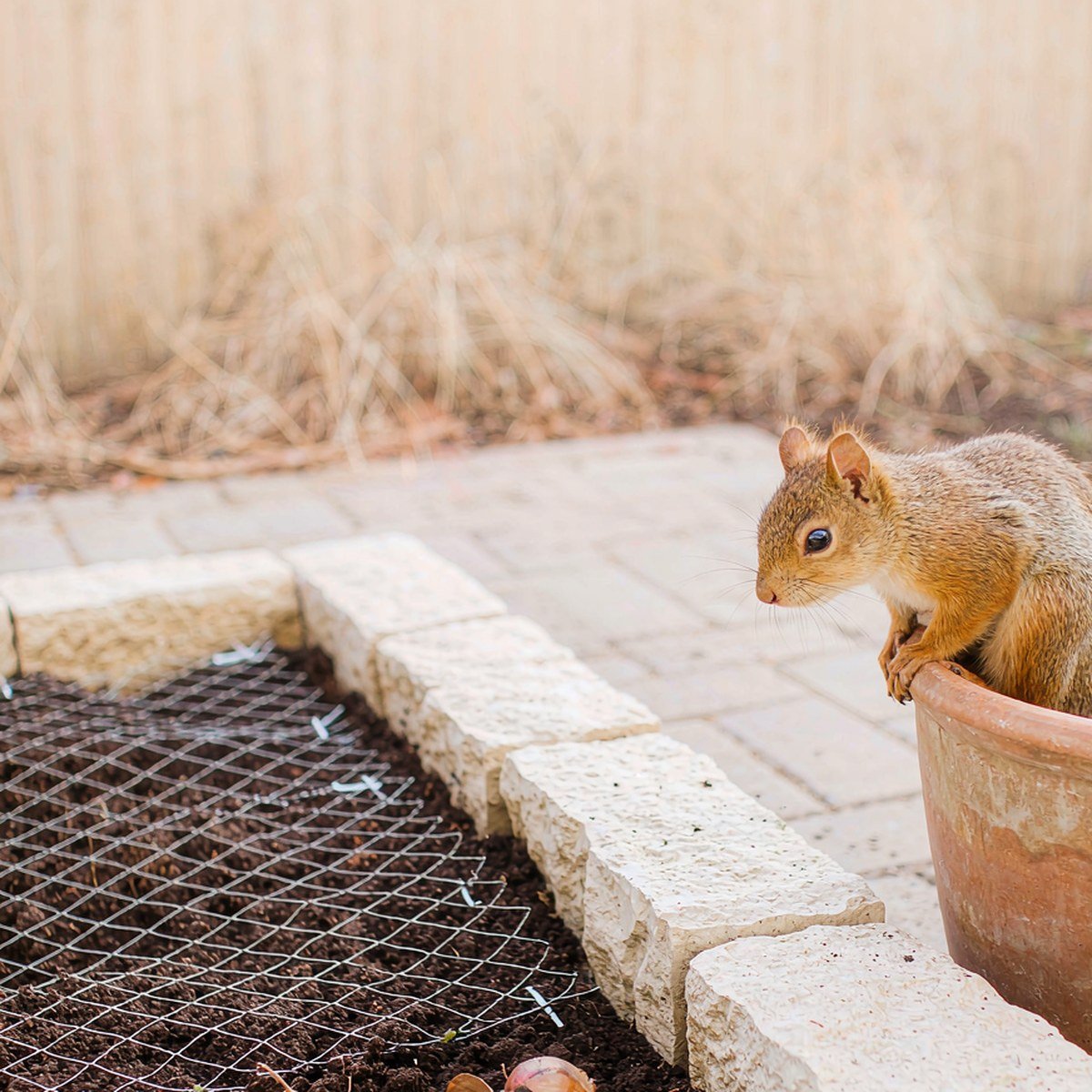
The cheapest season-long answer is a sheet of ½-inch mesh laid flat over the bed, pegged at the corners and along the edges, removed once the ground is frozen hard. Squirrels cannot dig through it and quickly lose interest. For a small bed, a rigid mesh cloche or a length of wire fencing bent into a tunnel does the same job and looks less improvised.
Repellents, honestly
Capsaicin, garlic and putrescent egg solids do deter, but only for one to two weeks and only until rain washes them off. They are useful for the fortnight between planting and hard frost, applied on a rotation so animals do not habituate. Do not use mothballs; they are not registered for garden use and contaminate soil. Treat every repellent as a delay tactic layered on top of a cage, never as the plan.
Voles are a different problem
If bulbs vanish and the surface is undisturbed, you do not have squirrels. Voles work underground along shallow runways, eating from the base up, and they leave narrow clipped paths through turf at the bed edge. A lid does nothing against them.
Against voles, use a basket with a closed base, or excavate the bed and lay two inches of sharp gravel beneath the bulbs as a floor they will not tunnel through. Keep turf mown and pulled back a foot from the bed edge, and clear mulch away from trunks and borders in autumn. Where voles are established, spring planting of susceptible bulbs is often wiser than autumn planting.
What they leave alone
Plant the vulnerable half of the garden inside cages and the resistant half outside them. Rodents avoid anything containing lycorine or calcium oxalate, which covers daffodils, hyacinths and most fritillarias, and they largely ignore anemones.
That makes a layered bulb scheme practical: purple and white tulips, red tulips and deep purple crocus in mesh baskets at the front, daffodils and hyacinths unprotected behind them, and the crocus that inevitably gets found treated as a decoy rather than a loss. Our snow crocus planting notes explain why the lawn species naturalise faster than the big Dutch hybrids and can absorb a little predation.
Pots and containers
Containers are raided more than beds, because a squirrel can dig a pot to its base in ten minutes. Cover the drainage holes with mesh from the inside before filling, plant the bulbs, then lay mesh over the compost surface and weight it with the pot’s own saucer or a ring of bricks.
If you are layering bulbs in a pot for a long spring display, the bulb lasagne method works exactly as written — just add the surface mesh as a final step. Bring pots against a wall for the winter; they dry out less and are dug less.
Order of operations for this month
Buy mesh before you buy bulbs. Cut baskets to size, plant late in the month when the soil has cooled, bag every skin, firm and water hard, grit the surface, and pin mesh over anything containing tulips or crocus. Browse the full tulip collection and the striped crocus mix to plan quantities, and remember that a cage you build once protects the same bed for a decade of springs.