
Blog
How Many Bulbs Do You Need? Planting Density by the Square Foot

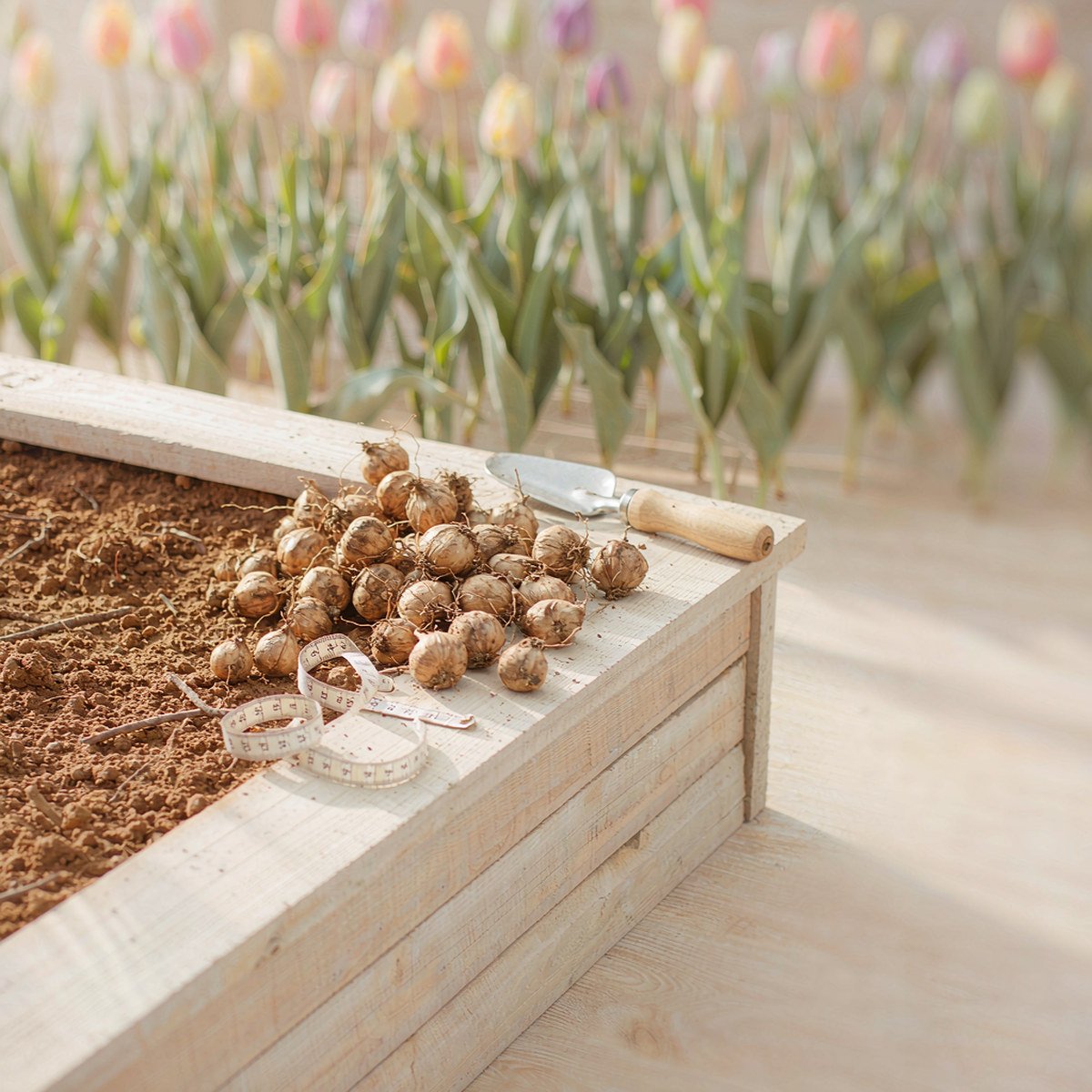
Quick answer: Multiply the bed area in square feet by the density for the genus. Tulips take about 5 bulbs per square foot, daffodils 4 to 5, hyacinths 4 to 6, crocus 9 to 12, and snowdrops 10 to 15. A 4 × 8 foot bed is 32 square feet, so it holds roughly 160 tulips or 320 crocus. For anything not on the list, space bulbs two to three times their own width apart and you will not be far wrong.
The rule behind every number
Bulb spacing is not arbitrary. A bulb’s roots work outward roughly one bulb-width in every direction, and its foliage needs room to lie flat and feed the bulb for next year. Space bulbs closer than two widths and the leaves shade each other; wider than three and the bed reads as scattered dots rather than a planting.
That single rule generates most of the figures people quote. A 12 cm tulip bulb wants about 15 cm between neighbours, which is 6 inches, which is about 5 bulbs per square foot. A crocus corm the size of a thumbnail wants 3 inches, which is 12 per square foot. Learn the rule and you can plant a genus nobody has written a table for.
Density by genus
These are figures for a bed where you want a solid show, not a specimen planting. Reduce by a third if you are interplanting with perennials that will fill in later.
| Bulb | Spacing | Bulbs per sq ft | 32 sq ft bed |
|---|---|---|---|
| Tulip | 5–6 in | 5 | 160 |
| Daffodil, standard | 6 in | 4–5 | 145 |
| Daffodil, species | 4 in | 8 | 256 |
| Hyacinth | 5–6 in | 4–6 | 160 |
| Crocus | 3 in | 9–12 | 336 |
| Snowdrop | 3 in | 10–15 | 400 |
| Grape hyacinth | 3 in | 12–15 | 432 |
| Anemone corms | 4 in | 9–12 | 336 |
| Ranunculus corms | 4 in | 9 | 288 |
| Freesia corms | 4 in | 6–8 | 224 |
| Bearded iris rhizome | 18 in | 0.5 | 16 |
Three looks, three densities
The same genus can be planted three ways, and the choice changes the count more than the species does.
Drift. Odd-numbered groups of 15 to 25 bulbs, spaced at the tight end of the range, with clear ground between groups. This is the density to use along a path or at the front of a border, and it is what most photographs of “natural” bulb planting actually show. Total count is lower than a solid block but the visual weight is higher.
Block. A solid rectangle or wedge at full density, no gaps. Formal, effective in a small garden, and the easiest to calculate — this is what the table above assumes.
Dotted. Single bulbs or pairs scattered at two to three times the recommended spacing. Cheap, and it looks like exactly what it is. Reserve it for large daffodil drifts in rough grass, where the eye cannot count.
A worked example, end to end
Take a bed 4 feet wide and 8 feet long against a south-facing wall. Area is 32 square feet. You want tulips at the back and crocus at the front edge, with a 12-inch strip of crocus along the 8-foot side.
The crocus strip is 8 × 1 = 8 square feet, at 10 per square foot, so 80 corms. The remaining 24 square feet take tulips at 5 per square foot, so 120 bulbs. If your tulips come in packs of 25, that is five packs with none left over; if they come in tens, buy twelve. Always round up on the genus that matters most to you and down on the filler.
Depth is a separate calculation and a separate mistake — our guide to tulip planting depth and spacing covers the vertical dimension, which is where most planting failures actually happen.
Containers: square feet are smaller than you think
A 12-inch pot has a surface area of about 0.8 square feet — less than a single square foot tile. That is why container plantings look sparse when people use bed densities.
- 12 in pot (0.8 sq ft): 6 tulips, 7 hyacinths, 9 crocus.
- 14 in pot (1.1 sq ft): 9 tulips, 10 hyacinths, 12 crocus.
- 16 in pot (1.4 sq ft): 12 tulips, 14 hyacinths, 16 crocus.
- 20 in pot (2.2 sq ft): 18 tulips, 21 hyacinths, 25 crocus.
Containers can run 30 to 50 percent denser than beds because competition for water and nutrients is managed by you, and because a pot of bulbs is meant to be a one-season display. The layered bulb lasagne takes this further: three genera in one pot, each at its own density, in three vertical layers.
Lawns and rough grass
Naturalising follows different arithmetic. You are not filling a bed, you are creating a colony that will spread, so bulbs go in at bed density inside irregular drifts and the drifts are spaced widely. For crocus in turf, 10 to 12 per square foot inside the drift is right; for daffodils, 4 to 5. The snow crocus guide sets out the drift shapes and the mowing timing, which matters more than the count.
The mistake here is spreading a fixed number of bulbs over the whole lawn. Two hundred crocus over 2,000 square feet is one bulb every ten square feet, and it will look like nothing happened. Two hundred crocus in three tight drifts of 10 square feet each will look like a meadow.
Turning counts into an order
Work backwards from pack size rather than forwards from the catalogue. Decide the area, multiply by density, then divide by the pack count and round up. A 100-square-foot border at 5 tulips per square foot is 500 bulbs — a serious order, and worth checking whether you actually want a solid block or would rather have 200 tulips in four generous drifts with room for perennials between them.
Bulb size belongs in the same calculation: a 10/11 tulip needs tighter spacing than a 12/14, because the flower is smaller and the plant shorter. Our explainer on what bulb circumference grades mean is worth reading before you finalise a quantity.
Where the count usually goes wrong
- Measuring the bed in feet but buying as if it were metres — a factor of ten.
- Using bed density in containers, which produces a pot that looks half empty.
- Forgetting that perennials will occupy a third of the bed by June.
- Ordering the exact count and then dropping a handful while planting.
- Spreading bulbs thin across a large lawn instead of concentrating them in drifts.
None of these are expensive mistakes, but they all produce the same complaint in April: “I planted hundreds of bulbs and it looks sparse.”
Start with the area, not the bag
Measure the bed, pick the genus, multiply. A mixed tulip pack at 5 per square foot, crocus at 10, hyacinths at 5 and ranunculus corms at 9 will fill a border properly the first year, and the anemones and bearded iris slot into the same arithmetic. If you are still deciding what to plant, the zone planting calendar tells you what is still worth ordering this month. Shop the range here and order to the count, not to the discount.